Americans Stopped Knowing Their Neighbors. We Designed a Home That Fixes That.
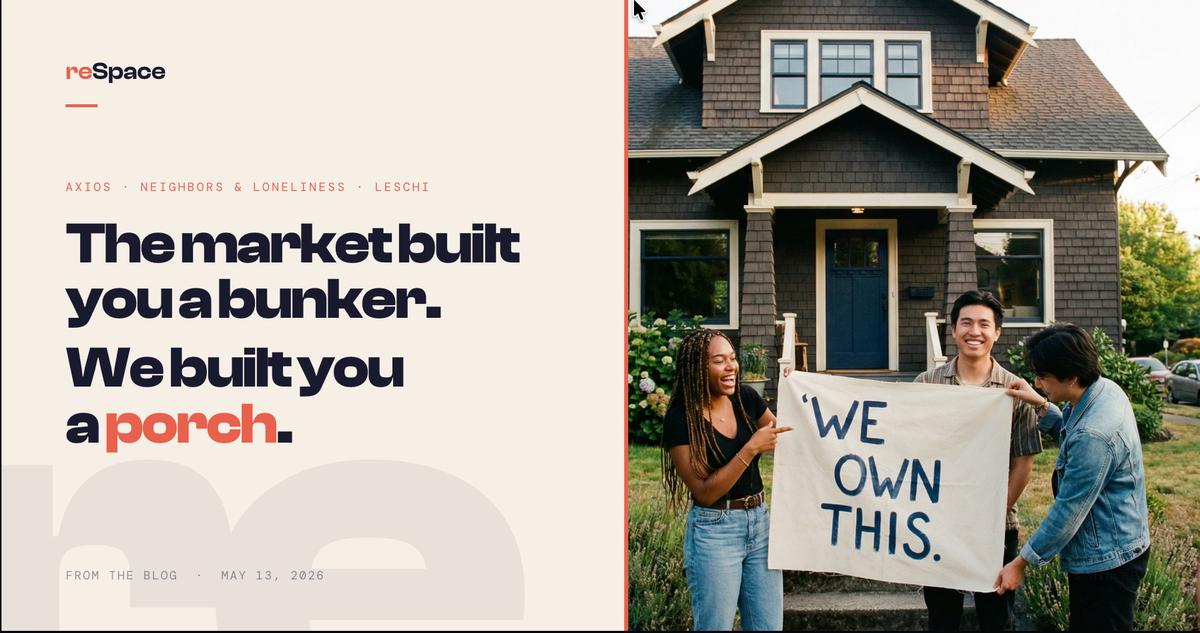
Axios just published a number that should stop you cold. In 2012, 59% of Americans chatted with their neighbors a few times a week. By 2025, that number had dropped to 41%. Among Americans aged 18 to 29, it collapsed from 51% to 25%. The next generation of homeowners does not know the next generation of neighbors.
The piece quotes Daniel Cox, director of the Survey Center on American Life:
"Homes have become entertainment bunkers."
He is right. And it is not an accident. It is a design choice that the American housing market has been making for forty years.
The reSpace co-homeownership home is the structural answer to that design choice.
59% → 41%
U.S. adults chatting with neighbors weekly, 2012 vs. 2025
51% → 25%
Adults aged 18 to 29, same metric, same period
$124,500
Starting price per suite, reSpace Leschi pilot
Why the data is worse than it looks.
The AEI report behind the Axios piece names the most common explanations: technology, the pandemic, remote work, declining religious attendance, frequent relocation. All true. All real. None of them, on their own, explain the cliff for young adults.
Half of the under-30 cohort dropped out of weekly neighbor contact in thirteen years. That is not a vibes problem. That is a built-environment problem.
The single-family home, designed for one nuclear family per parcel, surrounded by other single-family homes that contain other nuclear families, separated by lawn and fence and garage and door, is structurally efficient at one thing: producing privacy. It is structurally terrible at producing neighbors.
Add streaming. Add delivery. Add a remote job. Add a rent-to-income ratio that makes "host a dinner" feel like a luxury you cannot afford. The bunker is not a metaphor. It is a floor plan.
Why "be more social" is not the answer.
The standard prescription for the loneliness crisis is personal. Join a club. Go to church. Host a block party. Smile at the person who walks the same dog you walk.
These are good things. They are also wildly inadequate when the housing stock you live in was built to maximize distance from other humans.
You cannot self-help your way out of a built environment problem. You cannot book-club your way out of a floor plan.
What you need is housing that puts you in proximity to other people by design. Not roommates. Not a rental where everyone is transient and the operator owns the building. Owners. Neighbors who share the porch with you because they own the porch with you.
Co-homeownership, defined
A category of structured property ownership in which four to seven adults each hold a membership interest in a single-purpose LLC that owns one single-family home, with exclusive-use rights to a private suite (with a wet bar) and shared-use rights to common areas. Not co-living. Not roommates. Not a timeshare. A new category.
Curious how the Leschi home is set up?
Drop your details. We send the floor plan, the LLC structure, and what suites are still open. No call, no pitch.
What a home designed for connection actually looks like.
The reSpace home is a single-family property in a real neighborhood, where four to seven adults each own a private suite and share the kitchen, the living room, the porch, the yard. Each co-homeowner holds a membership interest in a single-purpose LLC. Each has exclusive-use rights to their own suite, with a door that locks and a wet bar. Each has shared-use rights to the common spaces.
You wake up. You make coffee in your kitchen, which is also someone else's kitchen. You see another human before noon, on a weekday, without having to schedule it. You sit on the porch in the evening and someone else is on the porch too. Not because you organized it. Because the floor plan organized it.
This is not communal living. This is not a commune. This is not a roommate situation that grew up. This is four to seven adults who each own a piece of one home, in a neighborhood they chose, with neighbors they share walls and a roof with.
It is the architectural opposite of an entertainment bunker.
Why the under-30 number matters most to us.
The same generation that watched neighbor contact get cut in half is the same generation that has been priced out of single-family homeownership in every major American city. These are not two separate stories. They are one story.
A 28-year-old in Seattle who cannot afford a $1.2M single-family home is not going to fix the loneliness crisis by being told to attend more block parties. She does not own a block. She rents a studio next to four other studios full of people she will never meet, because the building was designed to ensure she will never meet them.
What she could afford is a $124,500 suite in a Leschi co-homeownership home. Same neighborhood. Same trees. Same porch. Six co-homeowners she actually knows, because she shares a kitchen with them and her name is on the LLC with theirs.
This is what we mean when we say reSpace is a new category. Not a workaround. Not a compromise. A different answer to a problem the market has been failing to solve for two generations.
Why Leschi is the proof.
The first reSpace home is on a block in Leschi, in Seattle. Six suites, starting at $124,500. We just hosted the Co-Living Summit and Open House at the property.
If you read the Axios piece and felt a quiet, embarrassed recognition (yes, you also do not really know your neighbors, yes, you have become someone who waves through a window and that is the extent of it), the response is not guilt. The response is design.
The market built you a bunker. We built you a porch.
You belong in that neighborhood.
Always,
Rachael
Join the Leschi early-interest list.
You hear from us when there is something real to share. A new property, a tour weekend, a suite opening. No marketing emails in between.
Frequently asked
Questions people ask us about this.
What is co-homeownership?
Co-homeownership is a category of ownership where four to seven adults each hold a membership interest in a single-purpose LLC that owns one single-family home. Each co-homeowner has exclusive-use rights to a private suite (with a wet bar) and shared-use rights to the kitchen, living spaces, and outdoor areas. It is not co-living, not roommates, and not a timeshare.
How is co-homeownership different from co-living?
Co-living is rental: a third-party operator owns the building and residents are short-term tenants. Co-homeownership is ownership: four to seven individuals each hold a membership interest in the LLC that owns the home. Co-homeowners build equity; co-living residents do not.
How does co-homeownership address the loneliness crisis?
Co-homeownership puts owners in structural proximity to other owners by design. Shared kitchens, shared porches, and shared common spaces produce unplanned, low-friction daily contact with the people who own the home with you. The loneliness crisis is a built-environment problem; co-homeownership is a built-environment answer.
How much does a reSpace co-homeownership suite cost?
In the Leschi pilot in Seattle, suites start at $124,500. That is roughly the price of a one-bedroom rental in a market where the median single-family home is multiples of that.
Where is the first reSpace co-homeownership home?
The first reSpace home is in the Leschi neighborhood of Seattle, Washington. It contains six private suites and shared common areas, with co-homeowners holding membership interests in a single-purpose LLC.
Who can buy a reSpace suite?
Any individual who can qualify for the suite price (starting at $124,500 in Leschi) and is comfortable sharing common areas with three to six other co-homeowners. There is no age, profession, or family-structure requirement. Co-homeowners are selected through a structured matching and application process.
Why are Americans not socializing with their neighbors anymore?
According to AEI research cited by Axios on May 13, 2026, the share of Americans chatting with neighbors a few times a week fell from 59% in 2012 to 41% in 2025. For adults 18 to 29, the rate dropped from 51% to 25%. Researchers cite remote work, streaming, declining religious attendance, frequent relocation, and the design of single-family housing that maximizes privacy at the expense of connection.
Is reSpace an investment?
No. reSpace is homeownership. Co-homeowners purchase a membership interest in a single-purpose LLC that owns the property, with exclusive-use rights to a private suite. This is not an investment, and reSpace does not solicit investment.
Own the neighborhood.
The Leschi Collection is open now. More Seattle properties coming. The neighborhood you want is waiting.
Source: Josephine Walker, "Nobody's socializing with their neighbors anymore," Axios, May 13, 2026. Data from the American Enterprise Institute Survey Center on American Life.
Not an investment. Not a solicitation.